
In brief: Servo electric cylinder variable load selection starts with the whole load envelope, not one nominal force. Measure the lightest and heaviest workpiece and the motion cycle.
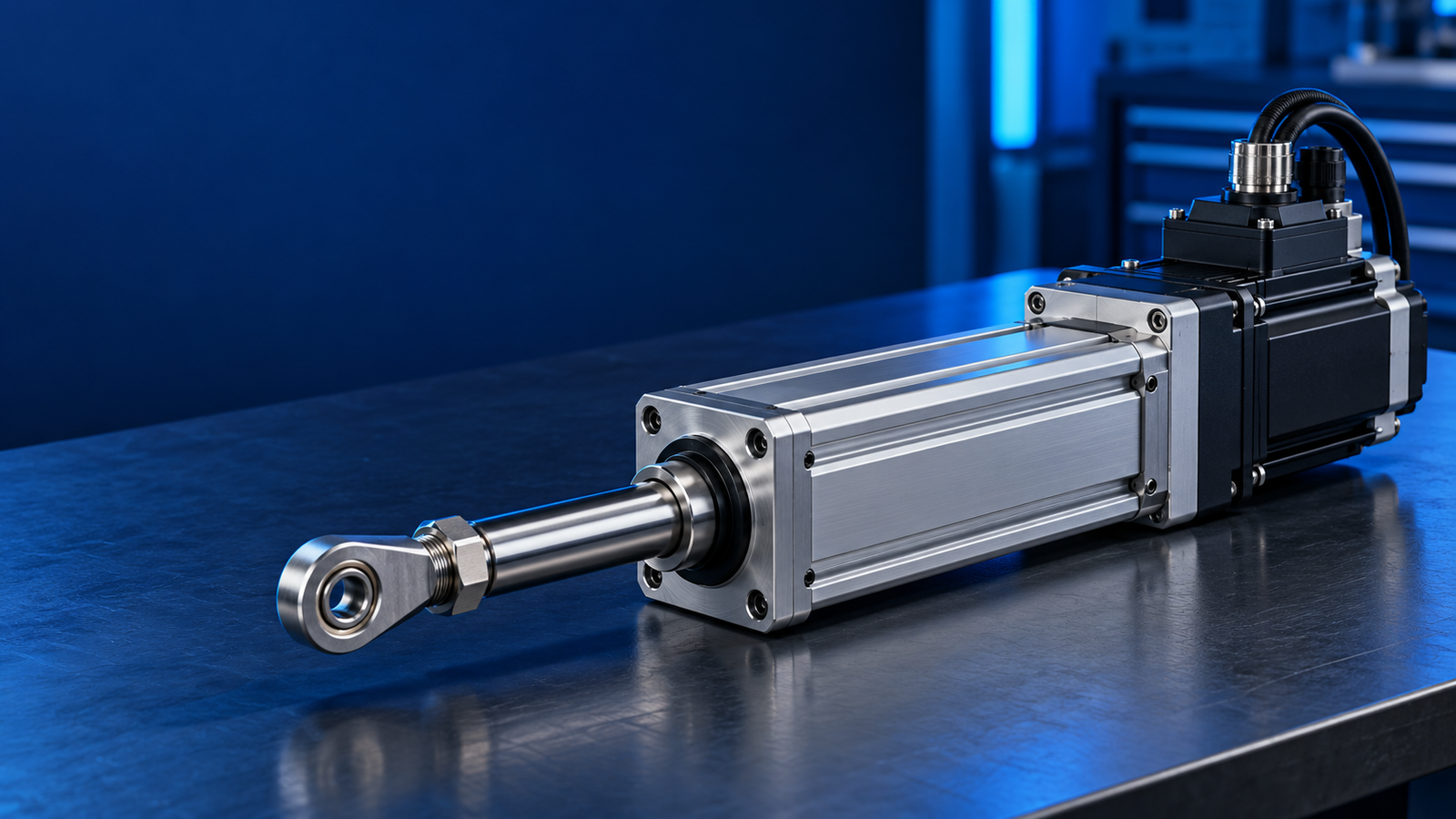
servo electric cylinder variable load selection: engineering checks
Use the application drawing, motion profile and exact component manuals. Record the operating baseline before changing settings so that a correction can be verified under the same load and cycle.
Map each load case
Record payload, process force, gravity direction, friction and acceleration at every segment. Identify both the peak and sustained force, plus how often each occurs. A short peak may be acceptable only within the model and drive limits.
Account for guidance and offset
An off-axis workpiece or flexible fixture can add side load and binding that a force calculation misses. Use external guidance for moments and align the actuator along the intended force path. Check the worst-case position across the full stroke.
Check the complete duty
Calculate cycles per hour, acceleration and dwell to assess motor heating and screw life. Test representative high-load and low-load cycles and record current and following error. A motor that passes one slow cycle may overheat in production.
Validate the selection
Compare the load envelope with the specific cylinder, screw, bearings, motor and drive documentation. Define allowable position error under load and any safety behavior at power loss. Request an engineering review with drawings and trace data.
What to document
- Actuator, motor and drive models, payload, stroke, orientation and duty cycle.
- Alarm code, current, command and actual position at the first symptom.
- Mechanical alignment, external guidance, travel limits and safety response.
- One controlled change and a repeat test under the full production cycle.
Frequently asked question
Can I use one force or accuracy value for every model? No. Ratings depend on screw, motor, drive, mounting and duty. Ask for the datasheet and a review of the actual load case.
For adjacent topics, see the NEFEIT resource center, selection guide and failure diagnosis. Contact NEFEIT engineering with your drawing and trace data. For general guidance on linear motion components, consult THK technical resources alongside the actual component manuals.