A servo electric cylinder may be evaluated for lifting containers beneath a filling head when the machine needs programmable positions for different container sizes or a controlled lift-and-lower sequence. Selection starts with the container mass and height range, travel, speed, acceleration, cycle timing, guidance, controls and environment—not a stroke number alone. The suitability of a particular NEFEIT configuration remains an engineering decision; this is an application-planning guide, not a delivered customer case or a performance claim.
Define the process before selecting the axis
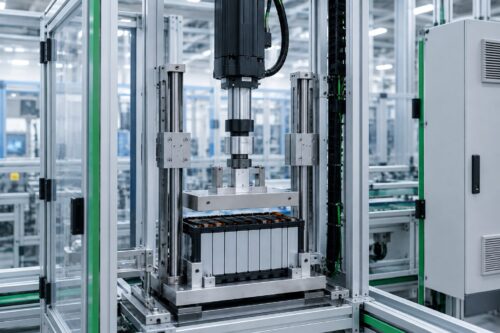
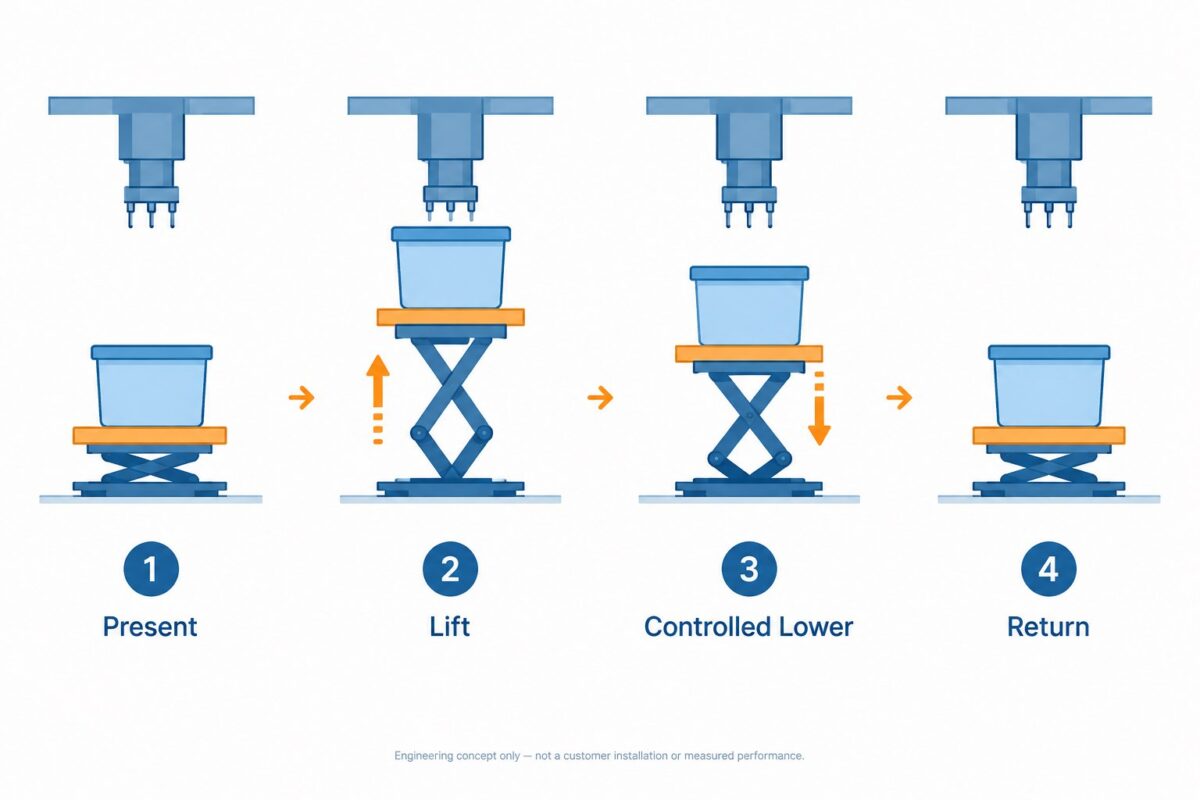
In one type of powder-filling machine, an empty rigid container is presented under the filling head, lifted toward the discharge tube, then lowered as product enters it. A published Tolomatic/All-Fill application describes this sequence and the need to adjust it for different container sizes. It is evidence that the machine problem exists—not evidence that NEFEIT supplied that system or would use the same actuator architecture.
For your machine, start with the actual sequence. Where is the container when the cycle begins? How close must it approach the filling head? Is the lowering motion synchronized with the filler, or is it a move between fixed positions? When may the next container enter? Answering those questions identifies the axis’s usable travel and timing envelope.
Build a recipe for every container format
“Programmable changeover” is useful only when the allowed ranges and references are defined. For each approved container, record the base diameter, height, empty and filled mass, location datum, lifting interface and permitted clearances. Then document the lift position, approach speed, lower trajectory and return position.
| Input | What to record | Why it matters |
|---|---|---|
| Container range | Minimum and maximum height, diameter and mass | Sets the travel and load envelope |
| Lift sequence | Start, approach, fill, lower, retract and dwell | Defines the motion profile and cycle exposure |
| Fill-head interface | Nozzle or tube clearance and allowable approach | Prevents a recipe from commanding interference |
| Guide and fixture | Support points, off-axis loads and moving mass | Separates carriage guidance from cylinder thrust |
| Controls | Format selection, interlocks, sensors and fault recovery | Makes changeover repeatable and reviewable |
Do not copy a motion profile from another machine. A faster approach is not automatically better when container stability, nozzle clearance or product flow sets the limiting condition.
Size the complete lift-and-lower motion
The moving load includes the container and the support or carriage that the actuator accelerates. For a vertical axis, gravity contributes to the required force; acceleration and deceleration change demand again. Product reaction, friction and any holding phase also need to be identified where relevant. Record values as measured, calculated or estimated rather than blending them into one unexplained “required thrust.”
The actuator, screw, motor and drive must be checked together at the needed force-speed operating points. Include cycles per hour, working hours per shift, loaded dwell and the time between containers. A brief peak and a repeated thermal demand are different checks. NEFEIT’s servo electric cylinder selection range is configurable, so no universal speed, thrust or duty rating can be inferred from this article.
Keep side loads out of the rod
If a container platform is offset from the cylinder axis, its guides and frame should carry the resulting moments. Define the vertical guide arrangement, connection joint, installation datums and available envelope. The cylinder should not be assumed to guide a cantilevered platform merely because its axial thrust is sufficient. NEFEIT’s existing carton-transfer study discusses the same separation of axial drive and external guidance for a different packaging task; its carton timing values do not apply to this lift.
Treat cleaning and product exposure as a separate gate
Packaging environments vary. Some axes are enclosed below the conveyor; others are exposed to powder, washdown chemicals or a product-contact zone. Identify the installation zone, dust, moisture, cleaning method, temperature and any applicable machine or food-contact requirements before choosing materials and protection.
Bosch Rexroth discusses industry-specific hygienic options for its own electromechanical-cylinder range. Those features and ratings must not be assumed for NEFEIT products. If your machine requires a verified washdown, hygienic, food-contact or hazardous-dust specification, request configuration-specific documents and stop selection until the requirements are confirmed.
Agree controls and validation before ordering
A practical controls brief states who selects the recipe, how the axis homes, what confirms a container is present, what permits movement near the filling head and how the machine responds to a missing, mislocated or jammed container. Define the required position feedback, motor/drive interface and ownership of the sequence between the actuator supplier and machine builder.
For acceptance, agree a test plan rather than an assumed result. Record the actual positions and timing for the smallest and largest approved containers, loaded and empty conditions, changeover behavior and recovery from defined faults. Verify the full cycle at the intended production exposure. Do not report reduced changeover time or improved filling quality until it is measured on the actual machine.
Container-lift RFQ checklist
Send the following for an initial NEFEIT configuration review:
- Container drawings, height/diameter and empty/filled mass range.
- Lift, lower, dwell and return positions and times for each format.
- Filling-head drawing, clearances and the machine’s format-selection logic.
- Moving carriage mass, external guidance, mounting datums and available envelope.
- Cycles per hour, shifts, environment, cleaning method and required protection documents.
- Motor, drive, voltage, feedback, controls and fault-recovery requirements.
- The acceptance measurements you expect at the machine, not an unsupported actuator-only accuracy promise.
Frequently asked questions
Can one servo electric cylinder handle several container heights?
Possibly, if every format stays inside the verified load, travel, speed, duty and clearance envelope. Each recipe and fixture variant needs its own limits and validation.
Does programmable motion guarantee a faster changeover?
No. It can remove some manual motion adjustment, but the result depends on container presentation, tooling, controls and the whole changeover procedure. Measure it on the actual line before making a productivity claim.
Is any NEFEIT cylinder suitable for food-contact or washdown use?
That cannot be inferred from this guide. State the exposure and cleaning requirements and request the applicable configuration and documentation before selection.
Turn the packaging task into a reviewable configuration
The value of an electric container-lift axis is the ability to define and verify the motion for each format, subject to the machine’s real constraints. NEFEIT can review the force, travel, duty, interfaces and available installation space when those inputs are supplied. Send the checklist and drawings through the engineering resources page to start a configuration discussion.
Sources and scope
- Tolomatic/All-Fill container-lift case — an example supplied by another manufacturer, not a NEFEIT customer case.
- Bosch Rexroth on electromechanical cylinders in packaging — industry context; its product-specific hygiene claims are not transferable.