
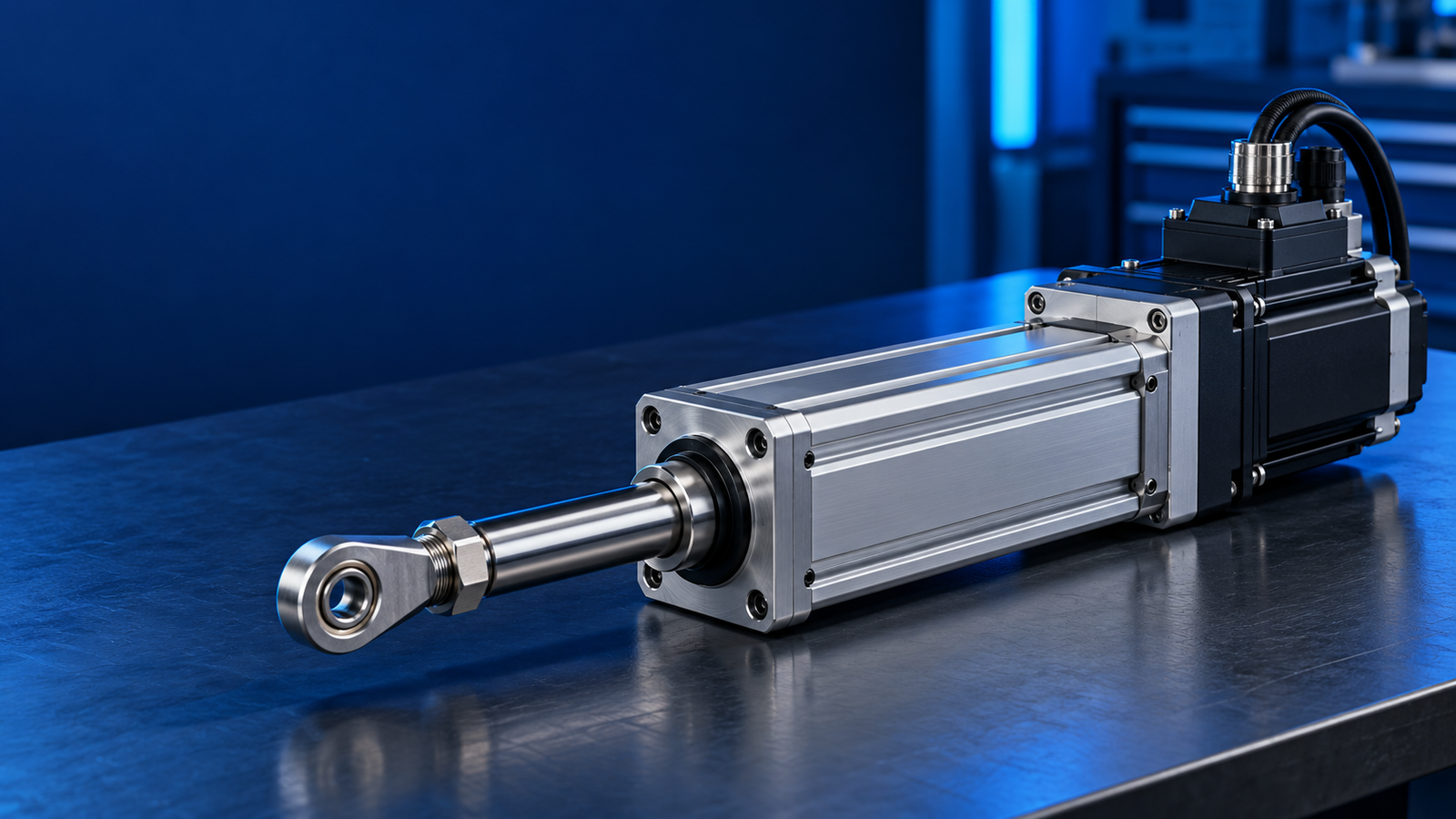
In brief: How to select a servo electric cylinder starts with the complete motion profile, not a peak thrust number. Define load, stroke, speed, acceleration, duty, mounting and guidance.
How to select a servo electric cylinder: load and cycle
Record the moving mass, external process force and load direction. For a vertical axis, include gravity and the effect of a power loss. Separate continuous force from brief peak force during acceleration, deceleration or contact. A simplified force estimate is process force plus the inertial term (mass × acceleration), friction and the gravity component; the actual design also depends on the machine geometry.
2. Specify stroke, speed and acceleration
Give the useful travel, end-clearance allowance, target move time and acceleration profile. Speed and thrust cannot be checked independently because screw lead, motor speed, torque and efficiency interact. A long stroke also requires checks for screw critical speed, buckling and guidance.
3. State accuracy in measurable terms
Distinguish repeatability from absolute positioning accuracy. Specify the load, direction, speed, temperature and measurement point used for acceptance. Backlash, screw lead error, structural stiffness, feedback and control tuning can all change the result.
4. Review mounting and side load
Choose an orientation and mounting style that fit the load path. If the tooling imposes lateral force or a moment, provide external guidance or select a guided configuration. Do not use the rod as an unintended guide. Share drawings showing the rod end, fixture and available installation space.
5. Verify the duty cycle and environment
Provide cycles per minute, dwell time, daily operating hours, ambient temperature, contamination, washdown or dust exposure. These affect lubrication, seals, motor heating and the expected service interval. The selected model must satisfy both short peaks and sustained operation.
6. Confirm motor, drive and safety interfaces
List the supply voltage, communication method, controller, feedback, limit switches and any holding-brake need. For gravity-loaded axes, a motor brake is not automatically a safety-rated holding device; use the machine-level risk assessment to select safeguards. See our engineering resource center for installation and troubleshooting topics.
Selection information to send NEFEIT
- Force versus position or process load, including peak and continuous demand
- Stroke, speed, acceleration, cycle time and daily duty
- Repeatability or accuracy target with test conditions
- Mounting drawing, orientation, side load and available envelope
- Power, controller, feedback and environmental requirements
Explore NEFEIT servo electric cylinders or request an engineering selection review. Final model ratings must be checked against the configuration-specific datasheet.