
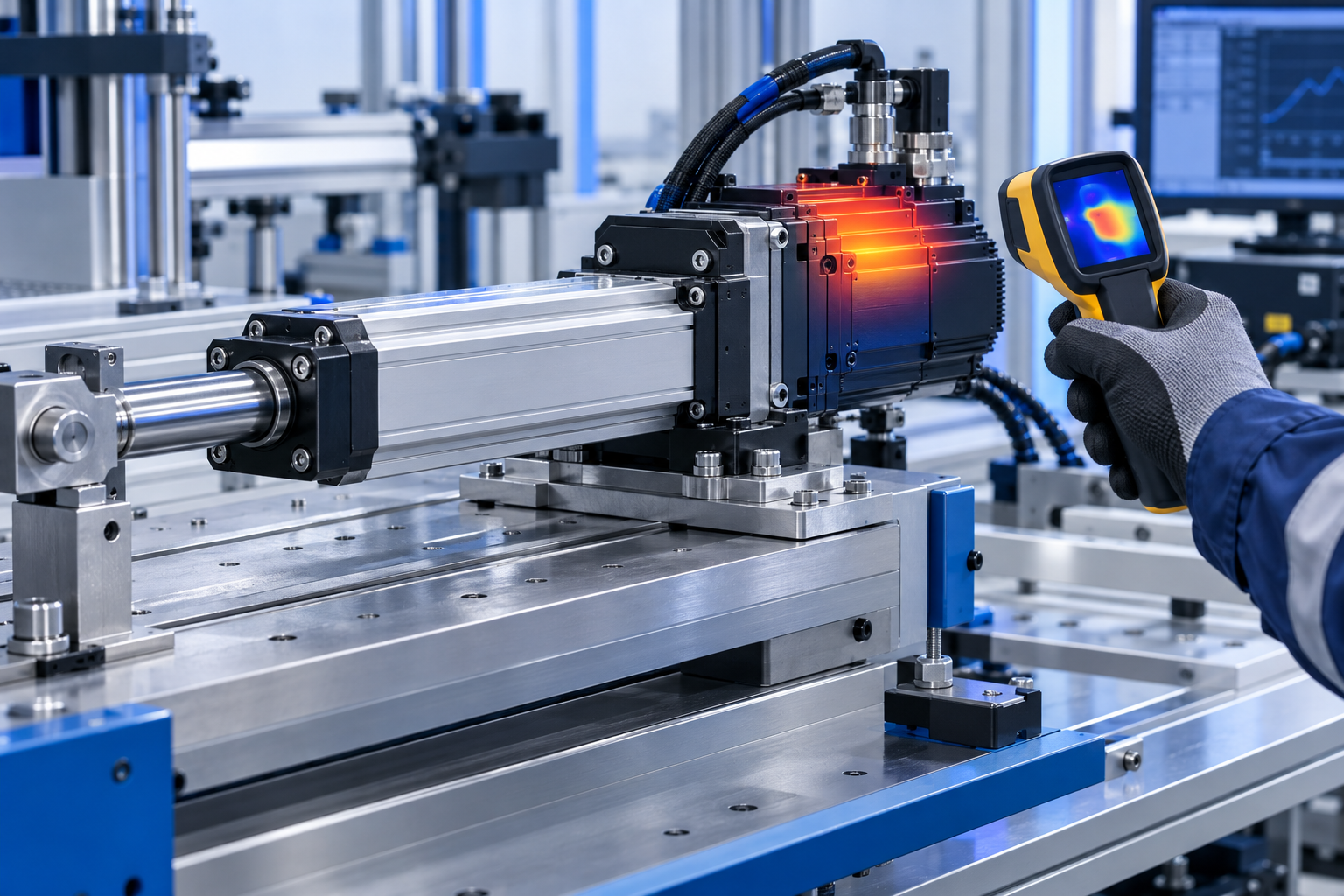
In brief: Servo electric cylinder overheating can result from excessive duty, friction, ventilation, sizing or drive settings. Stop if there is abnormal noise, smoke or repeated thermal alarms, then review current, temperature and the real motion cycle.
Servo electric cylinder overheating: five causes
There is no universal housing temperature limit for every servo electric cylinder. Compare measured motor, drive and actuator temperatures with the specific component ratings and ambient conditions in the manufacturer’s documentation. Record the measurement location, sensor method and steady-state duty before drawing a conclusion. A warm exterior alone does not prove a fault, while a drive thermal alarm or rising trend deserves investigation.
Five common causes of overheating
1. Load and duty exceed the continuous rating
Peak thrust is a short-duration value. Repeated acceleration, holding force or high cycle frequency can increase RMS torque and heating. Compare the full force, speed and dwell profile with the motor, screw and drive continuous limits. Review the selection guides if the application has changed since commissioning.
2. Binding, misalignment or side load
Check the guide rail, mounting surface, rod-end connection and coupling across the entire stroke. A cylinder that runs freely without the process load but heats under load may have alignment or guidance issues. Do not use the rod to compensate for an offset load unless the specific actuator is rated for it.
3. Lubrication or bearing problems
Inspect the screw, nut, bearings and seals for contamination, wear or insufficient lubrication. Follow the model-specific lubricant and interval rather than a universal cycle count. A change in noise, current or back-driving resistance can help locate friction.
4. Poor airflow or high ambient temperature
Measure ambient temperature around the motor and drive cabinet, not just elsewhere in the workshop. Check ventilation clearances, blocked filters and nearby heat sources. Confirm any added cooling method is suitable for the electrical enclosure and the actuator rating.
5. Motion profile or tuning
Frequent reversals and aggressive acceleration can raise current even when average speed is low. Compare commanded and actual speed, following error, current and torque. Change tuning only after mechanical resistance and load are understood, and follow the drive manufacturer’s commissioning procedure.
A practical diagnosis sequence
- Record the exact alarm code and when it occurs in the cycle.
- Measure ambient, motor and cylinder temperatures consistently; log current and position at the same time.
- Inspect mechanical alignment, guides, lubrication and ventilation with the equipment safely isolated.
- Compare peak and RMS demand with the rated operating envelope.
- Correct one cause at a time and repeat the full production cycle under the intended load.
For a related high-ambient application, see installation and operating guides. For a specific NEFEIT model, send the model, load profile, duty cycle, ambient temperature and alarm log for engineering review.
Frequently asked questions
Should the cylinder be replaced when it runs hot?
First verify measurements against the model ratings and identify friction, load or airflow causes. A larger actuator will not correct binding or poor alignment.
Can I keep running after a thermal alarm resets?
Repeated resets can hide a worsening mechanical or electrical problem. Record the alarm, investigate the cause and follow the equipment’s safety procedure before restarting.