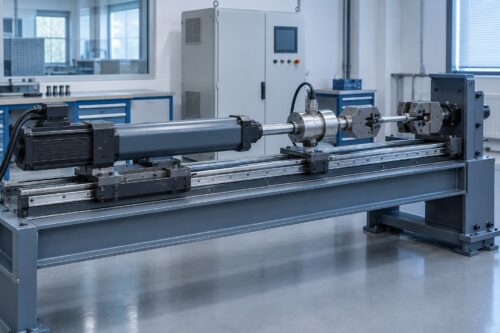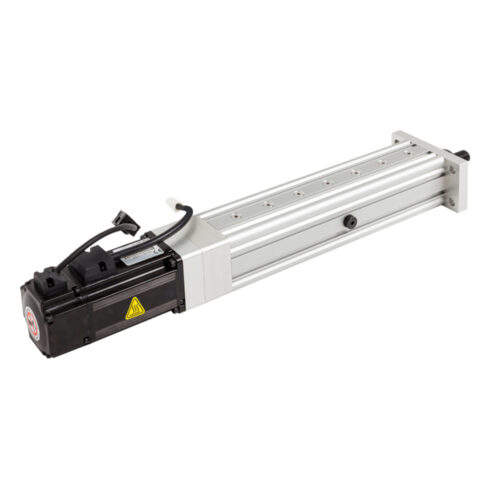
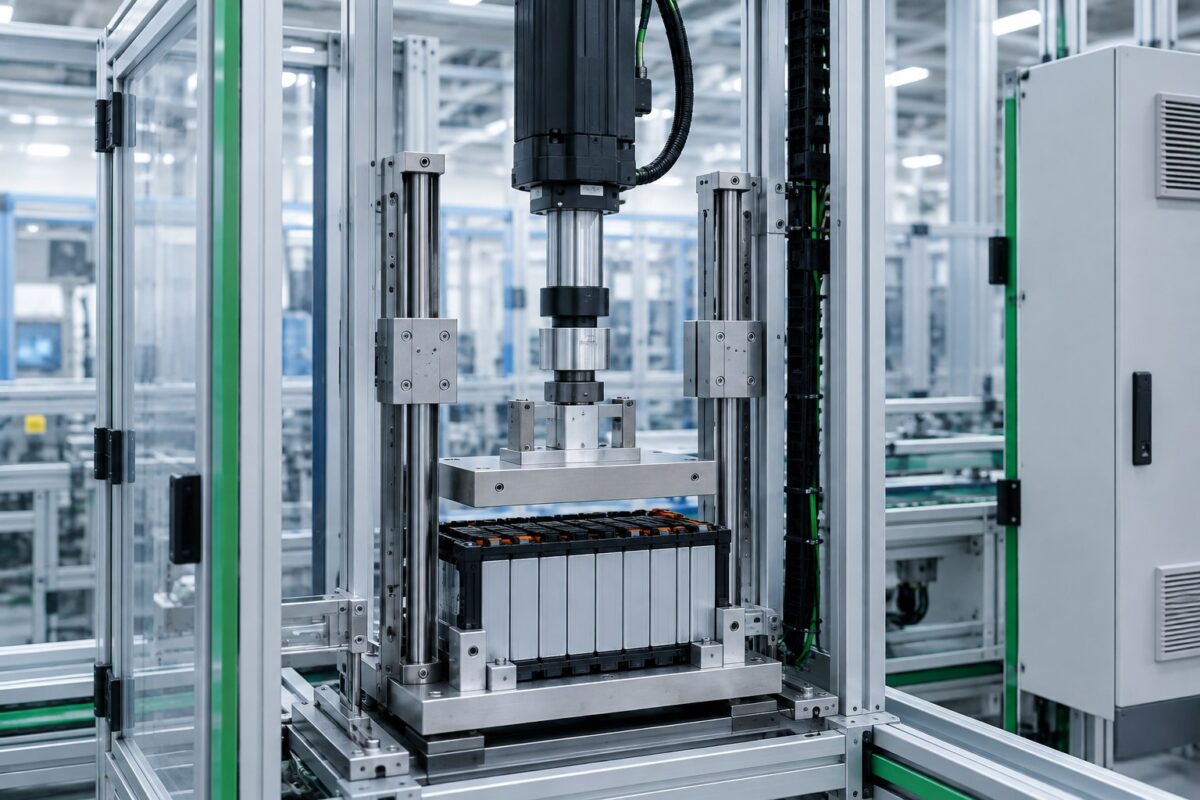
Servo electric cylinders can add value in battery manufacturing where a machine needs programmable linear force, position and speed rather than a simple two-position movement. Relevant processes include electrode compacting, controlled compression before cell insertion, module or pack assembly, guided positioning and production testing. The value comes from the complete actuator, servo, feedback, tooling and control system—not from the cylinder alone.
Start with the battery process, not the actuator
“Battery manufacturing” includes very different operations. A calendaring axis can require high continuous force and stiffness. A cell-handling axis may prioritize controlled acceleration and compact packaging. A test station may need a measured force-position sequence. These duties should not be grouped under one generic cylinder specification.
For every proposed axis, define the workpiece, load path, travel, force-versus-position requirement, cycle, environment, sensing and failure response before choosing a configuration.
1. Electrode compacting and calendaring
Electrode production includes coating, drying and compacting. Bosch Rexroth identifies battery calendaring as an application for high-power electromechanical cylinders, where force density, precision, dynamics and continuous-load capability matter.
The possible value of electric actuation is a programmable and repeatable linear setting within the complete roll-gap or loading mechanism. However, the engineering challenge is substantial. The designer must evaluate continuous and peak load, structural stiffness, parallelism, thermal behavior, screw and bearing life, lubrication, contamination and the response to a jam or power loss.
This is not automatically an application for a standard servo electric cylinder. High shock, extremely high continuous load or machine protection requirements may favor another actuation architecture. The comparison must be made against the real process cycle.
2. Controlled compression before cell insertion
For some prismatic-cell processes, the wound or stacked electrode assembly is compressed before it is inserted into the housing. Festo describes a servo-press package combining a screw-driven press cylinder, motor, drive, force sensor and controller for this type of electric pressing task.
Here, the potential value is not merely “high force.” It is the ability to define approach speed, compression travel, force limits and the transition between position and force control within a supervised process.
The machine builder still needs to establish:
- the permitted force and deformation window;
- tooling parallelism and external guidance;
- how the force sensor is mounted and calibrated;
- acceptable force–displacement signatures;
- reject criteria and data retention;
- part protection during a sensor, drive or power fault.
A servo cylinder does not create traceability by itself. Traceability requires identified parts, calibrated measurement, a controller, data storage and an agreed acceptance rule.
3. Module and pack assembly
Battery modules and packs involve cell handling, locating, clamping, insertion, adhesive processes and enclosure assembly. Festo highlights changing production volumes and geometries, occupational safety, monitoring, early error detection and tracking as important module-assembly concerns.
Servo electric cylinders may add value to selected guided axes through:
- programmable positions for different product variants;
- controlled acceleration when handling sensitive parts;
- repeatable clamping or insertion sequences;
- synchronization with sensors and the machine controller;
- compact inline or folded-back packaging when the machine envelope is restricted.
The rod should not be used as an unintended linear guide. Offset tooling, large moments or multi-point fixtures require external guidance and a defined load path. For vertical axes, assess gravity, holding behavior and the machine-level safety concept.
Battery handling also involves electrical and fire risks beyond motion control. Polarity checks, insulation, cell retention, guarding and safe fault response belong to the complete system design.
4. Production and end-of-line testing
Electric cylinders can support controlled loading in leak-test fixtures, connector checks, compression tests and other production verification tasks when the required force, speed and cycle fall inside the selected configuration’s envelope.
The value is a programmable test sequence and the ability to coordinate position feedback with a suitable load cell or other measurement device. Define measurement uncertainty, sampling rate, fixture stiffness, alignment and calibration before claiming that the station verifies product quality.
Long-duration fatigue or high-frequency testing may require a specialized test actuator rather than a general industrial cylinder. Frequency, waveform, reversal rate and thermal duty must be stated explicitly.
Match the value to the requirement
| Battery process need | Potential electric-cylinder value | Engineering condition |
|---|---|---|
| Multiple product variants | Programmable stroke and motion recipes | Confirm tooling, limits and validated recipes |
| Controlled compression | Defined position, speed and force sequence | Integrate calibrated force sensing and acceptance logic |
| Compact assembly cell | Inline or folded-back packaging options | Check full envelope, motor orientation and service access |
| Process monitoring | Position and force data from the complete system | Define sampling, calibration, part identity and data storage |
| Repetitive production | Repeatable commanded motion | Validate duty cycle, RMS load, temperature, lubrication and life |
Environmental suitability cannot be assumed
Battery production can impose dry-room, particulate, lubricant, chemical or restricted-metal requirements. A general industrial actuator is not automatically suitable.
For example, Festo publishes specific battery-production variants with reduced copper, zinc and nickel values. That evidence applies to those identified Festo products; it must not be transferred to a NEFEIT configuration. NEFEIT suitability requires configuration-specific materials, sealing, lubrication and environmental evidence.
Ask these questions before selection:
- Is the axis inside a dry room, clean area or ordinary factory environment?
- Are copper, zinc, nickel, silicone or other materials restricted?
- What particles, vapors, electrolyte or cleaning agents may reach the actuator?
- What sealing and cable protection are required?
- What maintenance can be performed without contaminating the process?
Data to send for a NEFEIT configuration review
Provide:
- a process and load-path sketch;
- moving mass and external process force;
- force versus position, including peak and sustained values;
- stroke, speed, acceleration, deceleration and dwell;
- cycles per minute, shifts and target service life;
- mounting orientation, side load and external guidance;
- available installation and maintenance envelope;
- motor, drive, PLC and communication requirements;
- sensor, force-measurement and traceability needs;
- temperature, humidity, particulate and material restrictions;
- safe state and expected behavior on power loss.
Use the servo electric cylinder selection guide to organize the load, cycle and installation requirements. Then compare the requirement with the available servo electric cylinder architectures.
When another technology may be better
Do not select an electric cylinder only because programmability is attractive. Pneumatic, hydraulic, linear-motor or specialized press/test systems may fit better when the application demands very high shock tolerance, extreme continuous force, very high cycling frequency, long travel, special cleanliness or certified machine functions that the proposed configuration cannot provide.
The right question is: which architecture satisfies the complete process, safety, environmental and lifecycle requirement with acceptable risk and cost?
Frequently asked questions
Can one servo electric cylinder design cover every battery process?
No. Compacting, cell insertion, module handling and testing have different force, speed, duty, guidance and environmental requirements.
Does an electric cylinder provide force traceability?
Not by itself. Traceability requires suitable force measurement, calibration, part identification, control logic, storage and acceptance limits.
Is a standard industrial cylinder suitable for a dry room?
Do not assume so. Confirm materials, lubricant, particulate behavior, sealing, cable system and maintenance method for the actual environment.
What is the first selection step?
Define the process segment and prepare a force-speed-time profile plus the installation and environmental constraints. A peak-force value alone is insufficient.
Review the process before selecting the cylinder
Servo electric cylinders can create practical value in battery equipment when programmable motion, controlled loading, variant flexibility or process data are genuinely required. The opportunity is strongest when the machine builder connects those benefits to a defined process and validates the complete system.
Send NEFEIT your process sketch, operating cycle and environmental requirements for an application-specific review. Final performance and suitability must be confirmed for the selected configuration.
Engineering references
- Bosch Rexroth: Battery production solutions
- Bosch Rexroth: High-power electromechanical cylinders in battery calendaring
- Festo: Automation for battery production
- Siemens: Battery cell assembly automation