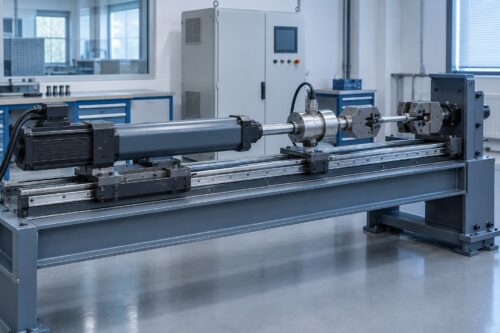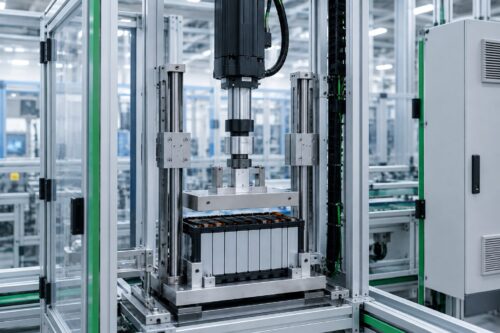
Choose an inline servo electric cylinder when the machine has enough axial space and a coaxial motor-to-screw layout fits the load path. Choose a folded-back design when installed length is restricted and the machine can accept additional width beside the cylinder body. This architecture decision comes before model selection: either arrangement still needs to be validated against load, stroke, speed, acceleration, duty cycle, mounting, external guidance, cable routing, environment and service access.
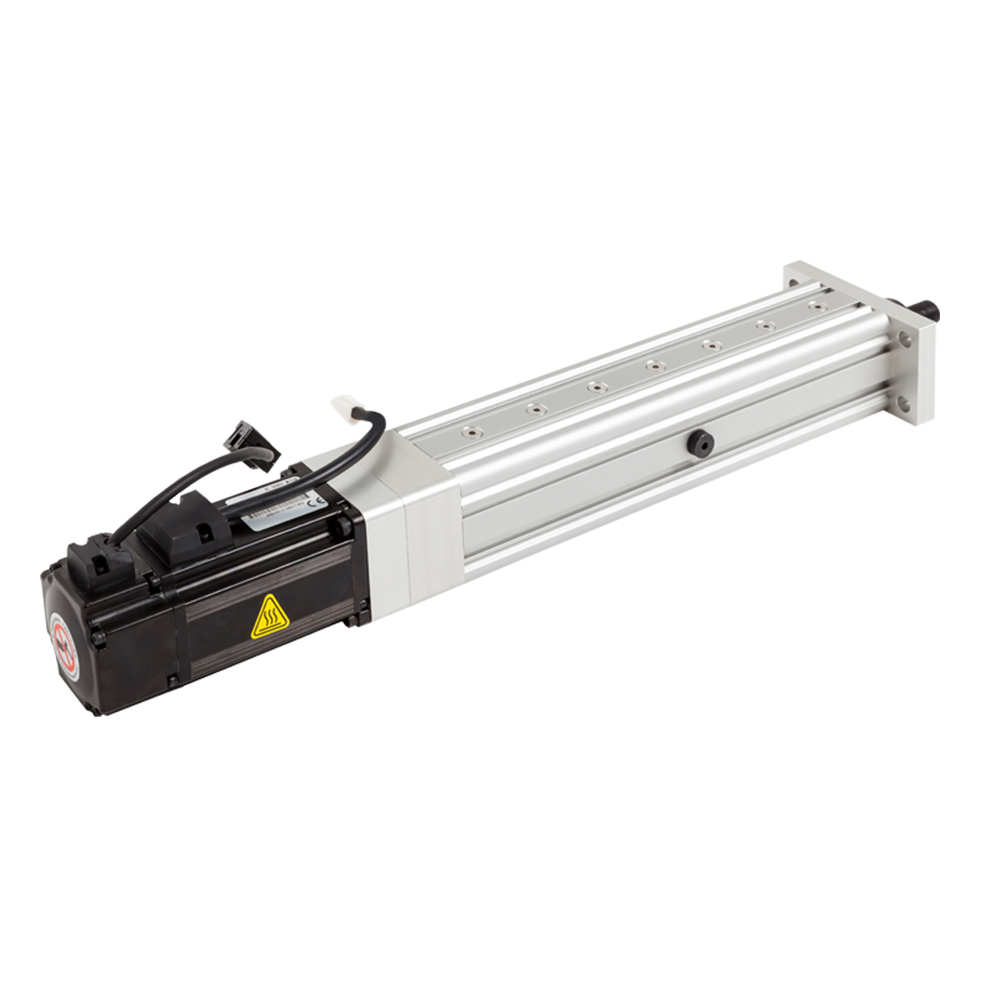
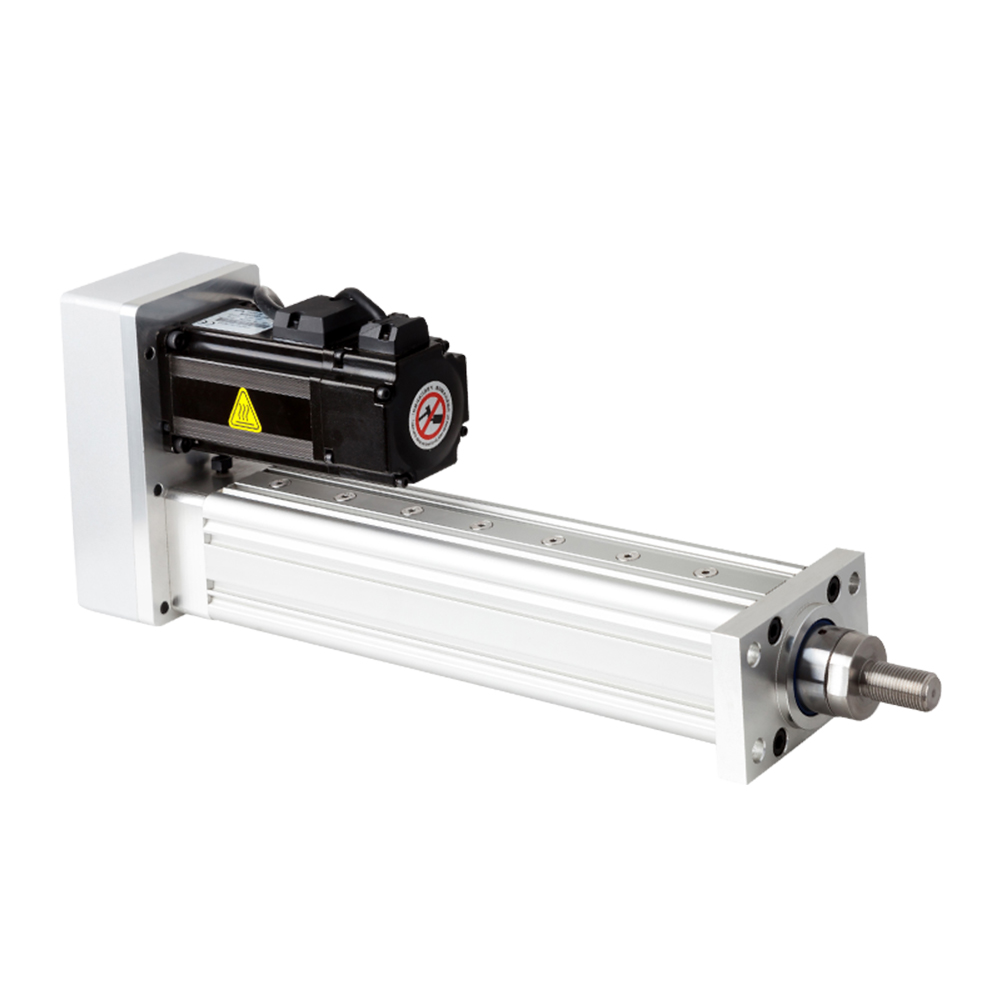
What changes between inline and folded-back architectures?
An inline servo electric cylinder places the motor shaft and screw shaft on the same axis. Power passes through a coaxial connection, such as a coupling assembly or a configuration-specific reduction mechanism. This creates a long, narrow package and can simplify integration when the machine has clear space behind the cylinder.
A folded-back servo electric cylinder places the motor beside the cylinder body, parallel to the screw shaft. A timing belt and pulley arrangement transfers power between the motor and screw. Moving the motor alongside the body reduces overall axial installation length, which can help when a guard, frame member or existing machine structure limits space behind the actuator.
Neither arrangement is universally better. The right starting point depends on which dimension is constrained, how the actuator will be mounted, where cables can bend safely, and whether technicians can reach the motor, transmission and lubrication points.
Inline vs folded-back decision matrix
| Design question | Inline arrangement | Folded-back arrangement |
|---|---|---|
| Available axial length | Requires room for the motor behind the cylinder | Reduces the installed axial envelope |
| Available lateral width | Usually keeps the package relatively narrow | Requires room beside the cylinder for the parallel motor and transmission housing |
| Transmission path | Coaxial motor-to-screw connection | Parallel motor with a timing-belt and pulley transmission |
| Motor orientation | Follows the cylinder axis | Can be reviewed around the side of the cylinder to suit the machine layout |
| Service planning | Provide rear access for motor, coupling and cables | Provide side and rear access for the motor, belt transmission, cables and covers |
| Best starting use case | New machines with clear axial space and a straightforward load axis | Compact machines, retrofits and restricted axial envelopes |
This table compares architecture, not rated performance. Force, speed, repeatability and service life depend on the complete actuator, screw, motor, drive, feedback, mounting and operating cycle. Do not assume that changing the motor arrangement preserves every other rating.
When is an inline servo electric cylinder the better starting point?
Start with an inline arrangement when the machine has adequate axial length and the actuator can align cleanly with the load. Typical design advantages include a narrow lateral envelope and a direct, easy-to-understand transmission path.
Check the full installed length rather than the cylinder body alone. The envelope must include the motor, adapter or reduction section, cable connectors, minimum cable bend radius, rear service clearance and the extended rod position. A layout that fits in CAD can still be difficult to wire or maintain if the motor connector sits against a guard or frame.
An inline arrangement does not eliminate alignment requirements. The cylinder must be mounted without binding, and the moving tooling still needs suitable guidance when it creates lateral force or overturning moment.
When is a folded-back servo electric cylinder the better starting point?
Start with a folded-back arrangement when axial length is the principal constraint. Placing the motor alongside the cylinder can make the package easier to fit in a short machine bay or retrofit where the original equipment frame cannot be extended.
The design must still reserve lateral space for the motor and transmission housing. Confirm which side of the cylinder can accept the motor, whether the cable exit conflicts with doors or guards, and whether service personnel can reach the belt cover and mounting fasteners. If the motor orientation is configurable, freeze that orientation in the released drawing rather than treating it as a field decision.
The timing-belt transmission is part of the selected configuration. Belt ratio, motor speed, torque, duty cycle and service requirements must be reviewed together. A folded-back arrangement should not be described as simply an inline unit with the motor moved to the side.
What architecture does not solve
Side load and external guidance
The output rod should transmit axial load. It should not become the machine’s unintended guide rail. Tooling that creates lateral force, eccentric load or moment needs external guidance or a guided actuator structure designed for that load. Rod-end bearings and clevises can accommodate defined articulation, but they do not replace external linear guidance.
Mounting stiffness and alignment
Front flange, rear flange, side mounting and custom interfaces create different load paths. The mounting structure must keep the cylinder aligned through the complete stroke. Misalignment and deformation can increase friction, produce binding and shorten service life, regardless of motor arrangement.
Force, speed and duty cycle
Architecture selection does not establish a model rating. Provide the force profile rather than one maximum number, and separate continuous demand from brief peaks. Specify useful travel, target speed, acceleration, dwell time, cycles per minute and daily operating hours. Long strokes and compression loads may also require screw critical-speed and buckling checks.
Machine safety
The actuator is one component in the machine. Guarding, travel limits, safe behavior on power loss, load holding and personnel protection require a machine-level risk assessment. A motor brake should not automatically be treated as a safety-rated holding device.
RFQ checklist for a validated configuration
Send the following information before selecting a model:
- A machine drawing or installation envelope with axial length, lateral width and service-clearance limits.
- Working and peak axial force, moving mass, orientation and any changing force over the stroke.
- Useful stroke, overtravel allowance, speed, acceleration and target cycle time.
- Cycles per minute, dwell or hold time, daily operating hours and target service life.
- Required positioning accuracy or repeatability, including measurement conditions.
- External guide arrangement, rod-end connection and mounting style.
- Preferred motor, drive, feedback, supply voltage and communication interface.
- Temperature, dust, moisture, washdown, lubrication and maintenance constraints.
- Motor-side preference, cable exit direction and required access to service points.
NEFEIT can review these inputs and propose an inline or folded-back configuration with the corresponding stroke, mounting and motor interface. Final capability should be confirmed against the released model designation, drawing and agreed operating cycle.
Frequently asked questions
Is an inline servo electric cylinder always more accurate?
No. Positioning performance depends on the screw, transmission, feedback, backlash, structural stiffness, assembly, load, temperature and control tuning. Compare configuration-specific data under stated test conditions.
Is a folded-back cylinder always slower because it uses a belt?
No universal conclusion is valid. Speed depends on screw lead, motor speed, pulley ratio, torque, load and duty cycle. Review the complete operating point.
Can I switch between inline and folded-back after the machine is designed?
Sometimes, but the installed dimensions, motor orientation, transmission ratio, mounting and cable routing may change. Treat the alternative as a new configuration and recheck the released drawing and motion cycle.
Which arrangement is better for a retrofit?
A folded-back arrangement is often a useful starting point when axial space is limited, but the machine must have enough side clearance and service access. The final choice still depends on the actual envelope and load path.
Prepare the machine envelope before choosing the model
The fastest way to narrow the architecture is to mark the available axial length, lateral width, motor side, cable route and service zone on the machine drawing. Then add the load, stroke, speed and duty cycle. Send those inputs to NEFEIT for a configuration review before finalizing the actuator model.
Internal resources: Inline Servo Electric Cylinders, Folded-Back Servo Electric Cylinders, How to Select a Servo Electric Cylinder, and Engineering Resources.
Engineering references: Bosch Rexroth electro-mechanical cylinder selection factors and Nook Industries electric cylinder design considerations.