
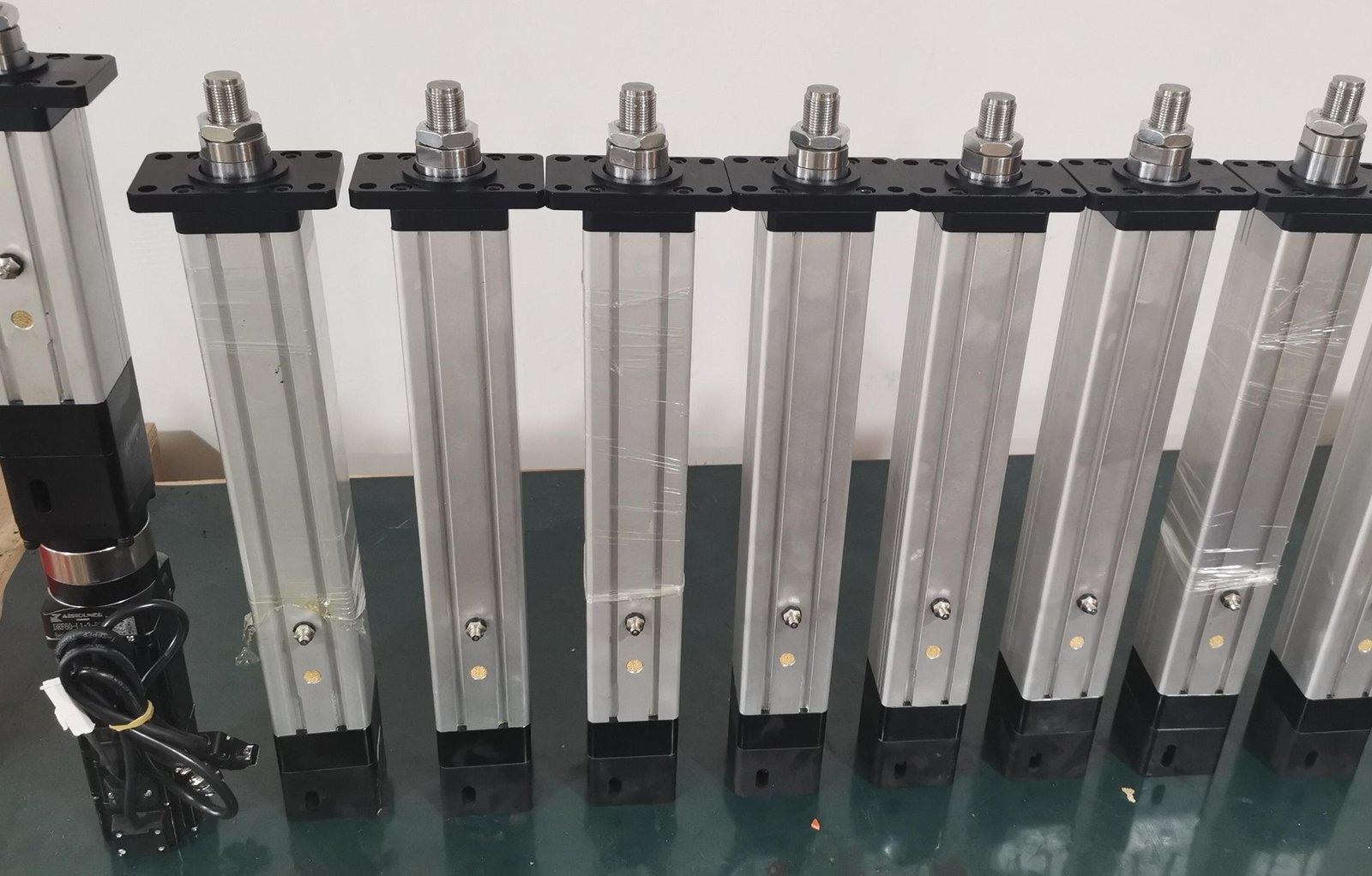
In brief: A parallel servo electric cylinder places the motor alongside the body instead of in line with the screw. This folded layout can shorten installed length, but adds transmission and service considerations.
Parallel servo electric cylinder: how it works
The servo motor rotates a transmission located beside the cylinder. That transmission drives a ball screw or other linear-motion mechanism, which converts rotation into rod travel. Encoder feedback and the servo drive close the motion-control loop. The exact coupling differs by product series, so use the configuration drawing rather than assuming all folded-back units are identical.
When it helps
Parallel mounting can fit a shorter machine envelope, particularly where there is space beside the actuator but little room behind it. The motor orientation may also improve cable routing and service access. It does not increase force or accuracy by itself; those depend on the motor, transmission, screw, structure and control system.
Trade-offs to check
- Envelope: measure total length, side clearance and the motor connector position.
- Transmission: confirm belt or gear rating, backlash, maintenance and efficiency.
- Performance: verify continuous and peak force, speed, stroke, repeatability and duty at the operating point.
- Installation: avoid side load, preserve access to guards and follow the mounting drawing.
Parallel versus inline servo electric cylinders
An inline layout places the motor on the actuator axis and can simplify the drive path, but may require more length. A folded-back layout moves the motor alongside the body. Choose the arrangement from the actual machine envelope and load path, then compare the configuration-specific data sheets.
Explore NEFEIT servo electric cylinder configurations, read the engineering resources, or send your installation drawing for an application review.